Capability Compounds, Discipline Doesn't
Why Smarter Models Still Need Guardrails
Every release makes models more capable. It does not reliably make them better behaved. Those are different axes, and the industry's roadmap quietly assumes they are one.
TL;DR
- The industry’s implicit roadmap says guardrails are training wheels: temporary scaffolding until models get smart enough
- That assumes capability and behavioral discipline improve together. They are separate axes
- Capability (reasoning, context, endurance) compounds across releases. Discipline (staying on scope, not doing unrequested work, not going lazy on stated work) is a per-release tuning artifact
- A release can overcorrect in either direction: too eager or too passive. Both are discipline failures with opposite signs
- Field observation: discipline can regress while capability jumps. You cannot assume the next model needs fewer guardrails
- Consequence: workflow modes, gates and scope contracts are containment, not crutch. Containment does not retire
The training-wheels assumption
Ask why an agent harness has modes, gates and scope contracts, and the standard answer carries an expiry date: current models need the help. The implication is a roadmap: models get smarter, oversight gets thinner, and the scaffolding comes down.
That roadmap rests on one assumption, so widely shared it is rarely stated: that a model getting more capable also gets better behaved. One axis, moving up and to the right, carrying both.
It is two axes. And they do not move together.
Two axes, not one
Capability is what benchmarks measure: harder problems solved, longer context held, longer tasks sustained. This axis has improved monotonically across frontier releases. Nobody disputes it.
Behavioral discipline is something else: staying inside the requested scope, not doing things nobody asked for, not quietly skipping parts of what was asked. It is how tightly a model adheres to explicit boundaries when no one is watching.
| Axis | What it is | How it moves |
|---|---|---|
| Capability | Reasoning, context, task endurance | Compounds release over release |
| Discipline | Scope adherence under no supervision | Reset by tuning choices, per release |
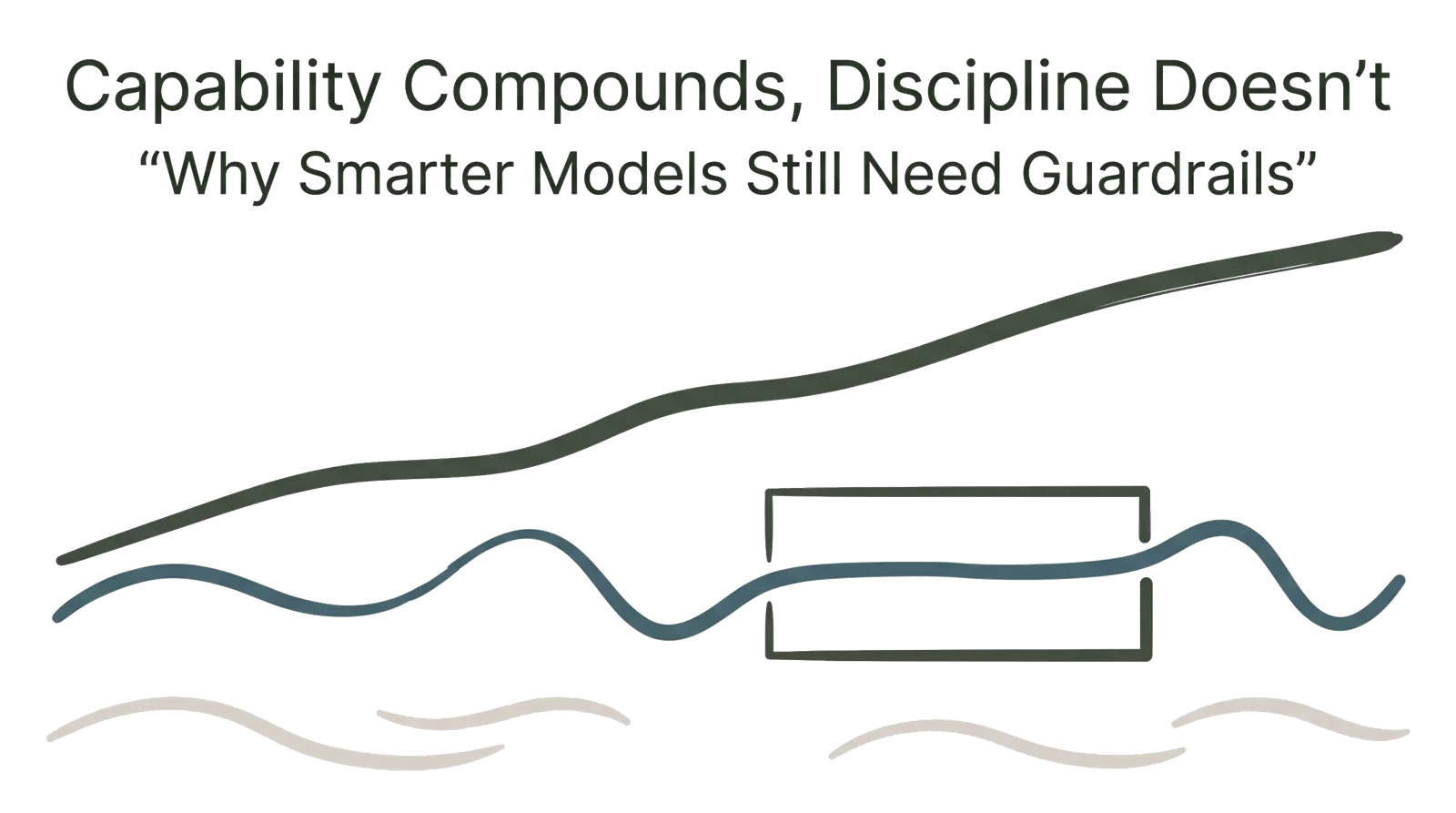
Discipline is not a capability that accumulates. It is an artifact of each release’s alignment tuning, and tuning can overcorrect in either direction: a release too eager, adding “helpful” work nobody requested, or a release too passive, going lazy on work that was explicitly stated. Both are discipline failures. They have opposite signs, which is exactly why the axis does not trend anywhere: it oscillates with tuning choices.
My own field observation, from daily heavy use of frontier models in agent harnesses across successive releases: discipline has not tracked capability. Newer, measurably more capable releases have been, at times, less disciplined than their predecessors, more prone to scope drift and unrequested action, not less. One practitioner’s logbook is not a benchmark, and I hold it accordingly. But the roadmap assumption fails on a single counterexample, and I keep meeting counterexamples.
Across three releases, capability rises while discipline oscillates around the same level. Two rows rather than one scale, because these are two axes and not two quantities.
Why nobody measures the second axis
Capability has benchmarks because capability is what sells. Discipline barely has a vocabulary.
Yet it is measurable. Scope adherence rate: how often did the agent stay inside the stated task? Unrequested-action rate: how often did it do things nobody asked for? Completion integrity: how often did it silently skip or downgrade stated work? Gate-failure rate per model version: how often did a workflow checkpoint catch an out-of-bounds transition?
These are exactly the numbers an instrument should emit: run the same harness, same cases, across model versions, and the discipline axis stops being anecdote and becomes a column in a table. Until teams do this routinely, every “the new model is better” claim conflates the axis that was measured with the axis that was assumed.
Containment, not crutch
If discipline tracked capability, workflow modes and gates would be a crutch: compensation for weakness, removable as strength arrives.
Since it does not, they are something else: containment. A mode boundary that says “exploring is not implementing” does not exist because the model cannot code. It exists because the transition between those regimes is where an undisciplined agent silently spends your review budget, whatever its benchmark scores. A gate at the merge point does not exist because the model’s work is bad. It exists because the model’s account of its own work is not evidence.
The design consequence is concrete: containment tightness becomes a per-model calibration, measured by gate-failure rate, not a fixed cost to amortize away. A well-behaved release earns looser gates; a drifty one gets tighter ones. The structure stays; the setting moves.
That is the reframe: the harness is not compensating for a deficit that time will fix. It is containing a variable that tuning re-rolls at every release.
What this means for the bet
This is the missing foundation under three arguments I have made separately: why verification structure does not retire as models improve, why structure compounds while trust resets at each release, and why a supervisor plane keeps the human at the gates regardless of which model executes.
All three reduce to the same claim: the axis your guardrails protect against is not the axis that improves. Betting your roadmap on discipline arriving with capability is betting on a correlation the field evidence does not support.
Take every capability gain. Swap models freely; the gains are real. But the day a release ships that is strictly more disciplined than its predecessor, and the release after that holds the line, you will still want the instrument that proved it, and the gates that were ready when it wasn’t.
Key Takeaways
- Capability and behavioral discipline are separate axes; only the first reliably compounds across releases
- Discipline is a per-release tuning artifact that can overcorrect toward eager (scope creep) or passive (silent laziness)
- Field evidence: more capable releases can be less disciplined; a single counterexample breaks the training-wheels roadmap
- Discipline is measurable: scope adherence, unrequested-action rate, completion integrity, gate-failure rate per model version
- Modes and gates are containment for a variable that re-rolls at each release, not a crutch for weak models
- Calibrate containment per model, by measurement. The structure stays; the setting moves
Authored by Davi Guides
Visit daviguides.github.io for more insights