The Refutation Ledger
Negative Knowledge Is Infrastructure
Positive knowledge ships as code. Negative knowledge ships as nothing, unless you give it a file. Why every system I run keeps a ledger of refuted ideas, and why agent fleets make it non-negotiable.
TL;DR
- Positive knowledge has an artifact: it ships as code. Negative knowledge, what was tried and disproved, ships as nothing
- Untracked refutations return: as the new hire’s suggestion, as your own idea six months later, as agent N+1 re-proposing what agent 3 disproved
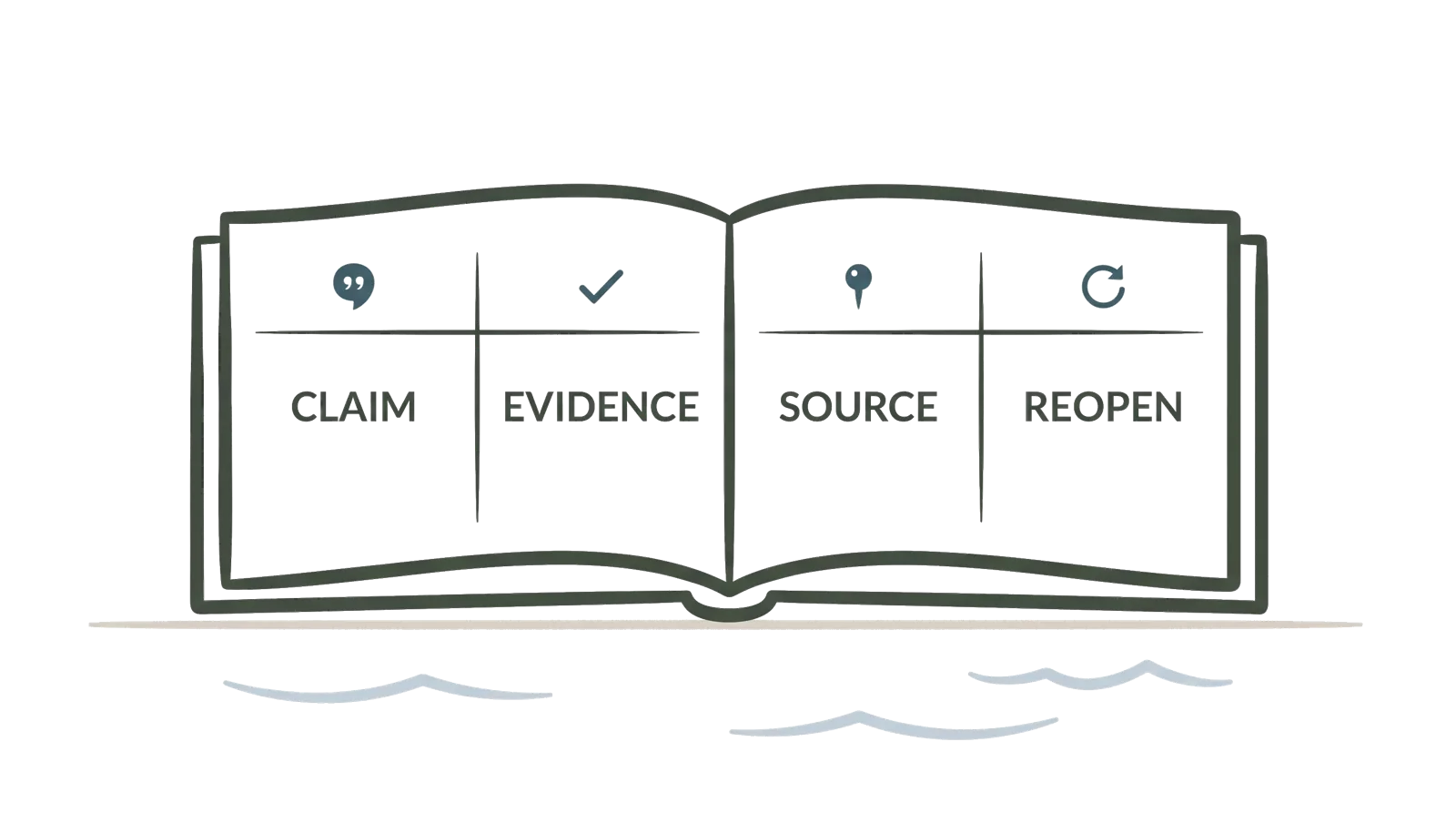
- A refutation ledger is one file: the claim, the evidence against it, where the evidence lives, and the condition for reopening
- “Do not retry without new evidence” is a gate, not dogma: new evidence legitimately reopens any entry
- ADRs record what you chose. The ledger records what you disproved. Different artifact, different failure it prevents
- Refutations compound: each entry permanently shrinks the search space every future explorer walks into
The asymmetry nobody manages
When an idea works, it leaves a trail: code, tests, a merged commit, a changelog line. The system itself is the record.
When an idea fails, it leaves nothing. The experiment gets deleted, the branch gets pruned, the conversation scrolls away. Three months later the organization has no institutional memory that the idea was ever tried, let alone why it lost.
So it returns. As the new teammate’s fresh suggestion. As your own idea, six months later, wearing a different hat. And in an agent fleet, as the proposal of agent N+1, generated with full confidence, re-litigating exactly what agent 3 disproved with data.
I learned to treat this as an operations problem while running thirteen agents in parallel: fleet memory is what stops the fleet from walking in circles. The fix is embarrassingly small.
One file, four fields
A refutation ledger is a single document, kept next to the code, where every disproved idea gets an entry:
- The claim. What was proposed, stated precisely enough that a future reader recognizes it when it resurfaces.
- The evidence. What was measured, and what the numbers said. Not “it didn’t feel right”: the benchmark delta, the failure mode, the cost.
- Where the evidence lives. The log, the branch, the results file. A refutation you cannot re-inspect is an opinion with a date.
- The reopening condition. “Do not retry without new evidence.” The clause matters: the ledger is a gate, not dogma. A new model, a new dataset, a changed constraint legitimately reopens any entry. What it forbids is retrying on vibes.
From my own ledger, de-identified but real: a learned sparse retrieval approach, tried and removed after it lost to the simpler hybrid on every honest measurement. A query-time expansion layer, rejected in favor of doing the same work once, at write time. A single-feature learned router that won offline and still wasn’t worth enabling in production. Each one is a sentence in a file. Each one has saved its cost several times over, because each one has been re-proposed since, by humans and by agents, and the answer took thirty seconds instead of a week.
Not an ADR
Architecture Decision Records solve an adjacent problem: they record what you chose and why, so the choice survives its author. The ledger records what you disproved and how, so the disproof survives its experiment.
The failure each prevents is different. Without ADRs, you forget why the system is shaped this way. Without a ledger, you pay for the same dead end twice. Teams keep the first and almost never keep the second, which is backwards: choices are at least embodied in the code, but a refutation has no other artifact. The ledger IS the artifact.
Why agents make this non-negotiable
A human team re-proposes a dead idea every few months. An agent fleet can re-propose it every few hours.
Agents generate plausible proposals at near-zero cost, and a proposal that was refuted by evidence the agent has never seen is indistinguishable, from the inside, from a fresh insight. Verification catches bad claims about what just ran; the loop’s trust layer is built for that. But nothing in the loop catches a proposal that is wrong for reasons established three weeks ago, unless those reasons are written somewhere the fleet reads.
That is the ledger’s operational role: it is the memory that makes exploration monotonic. Every entry permanently removes a region from the search space, for every future explorer, human or not. It is one of the quieter reasons structure compounds while trust resets: the instrument generates evidence, and the ledger makes the negative half of that evidence permanent.
An idea refuted without a record is an idea scheduled to return.
Key Takeaways
- Negative knowledge has no natural artifact; give it one file or lose it
- Entry format: claim, evidence, where the evidence lives, reopening condition
- “Without new evidence” keeps the ledger a gate instead of dogma
- ADRs preserve choices; the ledger preserves disproofs; keep both
- Agent fleets re-propose dead ideas at machine speed; the ledger is fleet memory
- Each refutation permanently shrinks the search space: negative knowledge compounds
Authored by Davi Guides
Visit daviguides.github.io for more insights